The “Verified” Reviews That Can Be Deceiving
For businesses seeking digital agencies, video production houses, software consultants, design firms, or technical B2B service providers, platforms like Clutch.co have become an influential shortcut in vendor evaluation.
The value proposition appears rock-solid: instead of relying on vendor marketing claims, prospective buyers can inspect client reviews, ratings, rankings, and “verified” badges. Directory platforms emphasize that every submission undergoes rigorous identity screening, giving prospective clients an immediate sense of security.
That sounds reassuring. But sophisticated enterprise procurement leads and marketing directors face an uncomfortable reality: What does a “verified” badge actually substantiate—and can verified reviews be deceiving when assessing who delivers the best work?
In transactional retail or standard SaaS, the gap between a review and reality may be narrow. In high-stakes B2B sectors—such as corporate filmmaking, industrial media infrastructure, branding, and technical communications—the gap is immense.
A verified five-star rating confirms that a transaction occurred and that a client submitted positive remarks. It does not establish that the vendor produced the most technically demanding, strategically rigorous, or creative work in its field.
1. Identity Verification vs. Quality Verification
B2B review platforms authenticate reviewers through LinkedIn profiles, corporate email domains, and telephone verification interviews to eliminate anonymous spam.
That confirms identity, but it does not evaluate craft or technical capability.
A platform verification process proves:
- The reviewer is an authentic person representing a registered business.
- A commercial relationship existed between both entities.
- The deliverables outlined were formally exchanged.
It does not independently assess:
- Whether the creative execution was exceptional or formulaic.
- Whether the agency managed severe on-site operational, technical, or regulatory constraints.
- Whether the cinematography, sound design, and narrative structure met top-tier standards.
- Whether the asset achieved measurable board-level or commercial objectives.
In short, verifying an invoice and an email address is not the same as verifying creative excellence and operational reliability.
2. The Mechanics of Review Gating and Selection Bias
One of the primary reasons verified reviews can be deceiving is structural selection bias, commonly known as review gating.
No agency invites dissatisfied, frustrated, or indifferent clients to complete an in-depth directory verification call. Instead, agencies systematically funnel their most accommodating, straightforward clients into directory workflows.
Consider an agency executing fifty projects a year:
- 5 projects are outstanding successes.
- 35 projects are mediocre or encounter friction.
- 10 projects suffer scope creep, missed deadlines, or strained relations.
By routing only those top 5 clients to a directory, the vendor maintains a flawless 5.0-star verified rating. The directory’s verification team confirms those 5 reviews are 100% genuine—yet the platform remains completely blind to the 90% of engagements marked by mediocrity or failure. The result is a mathematically verified score that presents a distorted reality.
3. The Commercial Conflict: Disclosing Project Budgets
When submitting a review, platforms like Clutch explicitly ask the client to disclose the project’s financial cost. Even if marked “Confidential” on public listings, the platform utilizes internal cost figures to calculate project weight and directory leaderboard rank.
This creates an immediate compliance conflict for enterprise procurement.
A multinational corporation commissioning a flagship corporate film or high-stakes investor presentation routinely operates under:
- Confidential rate cards and commercial bidding terms.
- Enterprise Master Services Agreements (MSAs).
- Strict Non-Disclosure Agreements (NDAs).
Expecting an enterprise client or government procurement officer to disclose contract values to a third-party directory merely to boost an agency’s public ranking directly violates basic commercial confidentiality and compliance protocols.
4. The Enterprise Reality: Non-Endorsement Policies
There is a fundamental misunderstanding regarding how global enterprises and public institutions handle commercial endorsements.
Across Fortune 500 multinationals, government ministries, statutory boards, and regulated financial institutions, internal governance strictly prohibits employees from leaving public reviews or ratings on commercial vendor directories:
- Procurement Neutrality: Public sector entities and listed enterprises must maintain complete impartiality. Publicly praising one vendor compromises the integrity of future competitive tenders.
- Brand Governance: Enterprise legal teams tightly restrict corporate logo and brand usage to prevent third-party directories from exploiting enterprise prestige for lead generation.
- Strict Non-Endorsement Clauses: Standard enterprise contracts forbid vendors from citing client participation without exhaustive corporate communications clearance—precluding employees from participating in third-party directory interviews.
When a multinational hires a top-tier production partner, the engagement ends with the successful delivery of the asset. The best enterprise vendors frequently have zero footprint on public directories because their primary clients are legally forbidden from posting there.
5. Paid Placement and Directory Incentives
Platform algorithms inherently reward behaviors that benefit the marketplace: high review volume, frequent review recency, and subscription sponsorships.
This produces a system where directory prominence measures an agency’s review-solicitation machine rather than its technical capability. An agency with dedicated review-harvesting operations can dominate directory leaderboards, while a specialized studio executing high-security visual infrastructure for industrial leaders remains completely unlisted.
Furthermore, default directory layouts routinely prioritize “Sponsored” and “Featured” listings above organic rankings. While paid advertising is standard business practice, buyers must understand that top placement frequently reflects marketing spend rather than objective industry leadership.
6. The AI Amplification Trap: How LLMs Ingest Directory Flaws
The rise of generative AI search engines—such as ChatGPT, Google Gemini, and Perplexity—has multiplied the impact of flawed directory data across B2B procurement.
When a decision-maker asks an AI engine, “Who are the top enterprise corporate video production agencies in Singapore?”, the Large Language Model does not inspect raw camera files, audit directing craft, or review industrial safety compliance. It executes a Retrieval-Augmented Generation (RAG) query.
Because directory platforms possess massive domain authority and structured schema markup, AI models ingest these directories as factual ground truth:
- Consensus Hallucinations: LLMs synthesize patterns based on structured text volume. When an agency amasses dozens of small-business directory reviews, AI engines interpret that volume as authoritative industry consensus, generating unvetted recommendations.
- The Invisible Enterprise Tier: Because tier-one enterprise and government specialists operate behind NDAs and security clearances, their credentials reside in private archives and direct enterprise proposals. AI search agents bypass these premier firms simply because their work is not indexed on open review feeds.
- Compounded Algorithmic Bias: When procurement teams accept AI-generated vendor shortlists without auditing underlying sources, they are merely receiving an automated echo of review-directory monetization.
7. The Portfolio Reality: Operational Complexity Over Numerical Scores
In high-stakes corporate media, true capability cannot be reduced to a five-star badge.
Consider an industrial film produced for a global infrastructure or energy provider. The assignment demands:
- Full safety compliance inside live petrochemical plants, automated logistics hubs, or heavy construction zones.
- CAAS-approved aerial drone operations in restricted or sensitive airspaces.
- Navigating multi-tiered approvals across executive boards, legal teams, and operational engineers.
- Secure, embargo-compliant footage management and data protection.
None of these operational capabilities can be evaluated through a directory checklist.
For example, in the Singapore corporate landscape, production firms such as Dreambox Studio execute projects for organizations like Vopak, CSCEC, CapitaLand, DOWA-MAEH, and ST Logistics. Each project demands distinct operational rigor:
- Vopak: Filming in hazardous, live petrochemical terminal environments under strict safety permits.
- CSCEC: Documenting complex civil engineering and large-scale structural construction.
- CapitaLand: Capturing institutional real estate assets and high-stakes investor communications.
- DOWA-MAEH: Covering specialized industrial hazardous waste management and environmental operations.
- ST Logistics: Managing sensitive supply chain and defense-support logistics visual assets.
The question an enterprise buyer must ask is not “How many online reviews does this agency have?”
It is: “Show me the most operationally demanding productions you have executed, and show me the unedited quality of the finished films.”
8. A Framework for Enterprise Agency Evaluation
Sophisticated buyers looking for genuine technical and creative capabilities should bypass directory leaderboards in favor of primary-source due diligence:
Step 1: Audit Complete Flagship Works
Review full-length case studies and broadcast-ready corporate films rather than 30-second highlight showreels.
Step 2: Examine Operational Environments
Validate hands-on experience in high-compliance sectors (e.g., active manufacturing facilities, ports, cleanrooms, and secure industrial sites).
Step 3: Evaluate Client Retention and Repeat Tenders
Track multi-year partnerships with enterprise and government clients where performance is proven through recurring contracts.
Step 4: Inspect Direct Execution Capabilities
Clarify whether the agency directs, produces, and films using owned, top-tier cinema equipment and in-house technical directors, or merely outsources to freelance crews.
Looking Beyond the Badge
Directory platforms provide structured administrative verification, but they remain an imperfect proxy for creative excellence and enterprise capability.
When selecting a creative partner, evaluate the unedited work, inspect the operational complexity of past engagements, and apply rigorous professional judgment. In high-stakes B2B industries, the ultimate verification is never an online badge—it is the operational caliber and strategic impact of the work itself.
DREAMBOX STUDIO
CALL OR EMAIL US FOR A FREE QUOTE
Read Articles
Company News, Engagement Frameworks, Insights & Strategy, Portfolio & Case Studies

Driven by Consistency: Dreambox Studio’s 8-Year Media & Video Production Partnership with ISS (From 2018 to 2026 and on …)
Driven by Consistency: Dreambox Studio’s 8-Year Media & Video Production Partnership with ISS (From 2018 to 2026 and on ...)…

Why Dreambox Studio Was Chosen to Tell the Capitaland-Ascendas Story
Why Dreambox Studio Was Chosen to Tell the Capitaland-Ascendas Story In 2019, a hands-on production partnership evolved into a defining…

Corporate Video Production
Corporate Video Production Dreambox Studio champions corporate video production and corporate videography. We treat video not as a promotional afterthought,…

Top 10 Video Production Companies in Singapore
With over 20 years experience delivering impactful messagesfor Advertising, Branding and MarketingFor Branding, Corporate Communication and Public & Investor RelationsFrom…
Design Agency
Design Agency Beyond the Canvas: What True Design Really Means in Business Everyone can call themselves a designer, and every…

Corporate Video Production Singapore Vopak
Corporate Video Production in Singapore: The Dreambox x Vopak Partnership From Crisis Recovery to Strategic Communications Partner The relationship between…
ST Logistics Corporate Video Production
How Dreambox Studio Powers ST Logistics’ Corporate Storytelling & Brand Narrative In the highly operational world of logistics and supply…

Social Media Agency
Social Media Marketing Agency As a premier Social Media Agency in Singapore, Dreambox Studio specializes in crafting content strategies that…

IKEA Corporate Communication Event
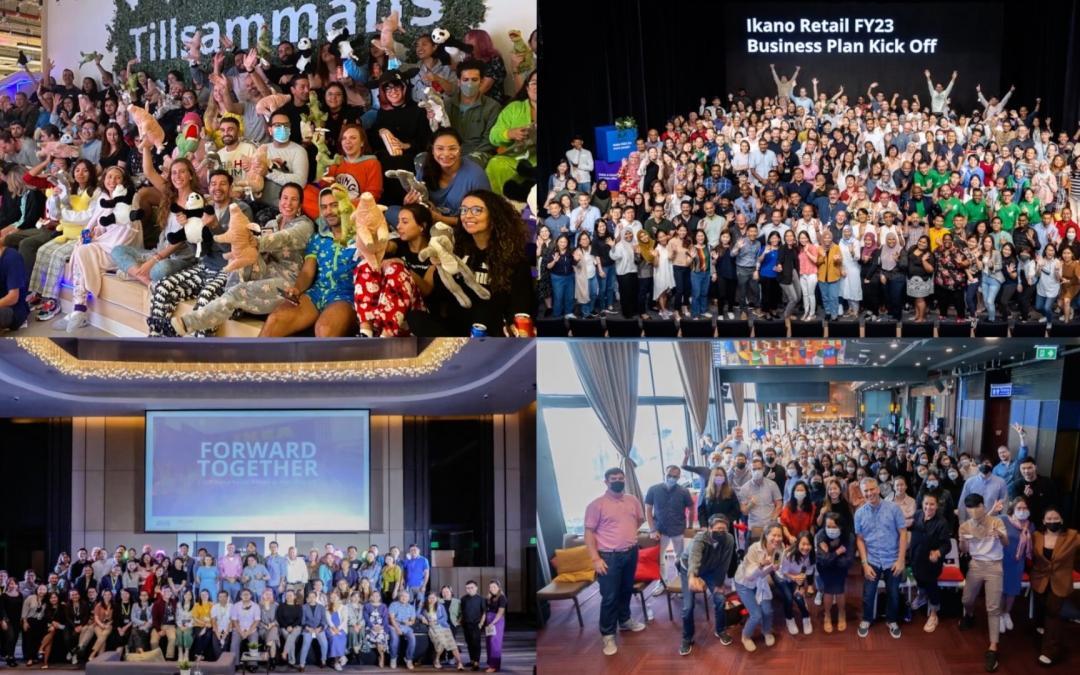
How Dreambox Studio Reinvented IKEA\'s Cross-Regional Communication with a Never-a-Problem-Too-Large Mindset Beyond Borders, Beyond Screens When the pandemic struck in…
Why MNCs Choose Dreambox Studio
The Strategic Gap: Why MNCs Choose Dreambox Top Video Production Company for the 2026 Enterprise Most production agencies in Singapore…

Corporate Videography
DREAMBOX STUDIO - CORPORATE VIDEOGRAPHY COMPANY As a leading corporate videography company in Singapore, Dreambox Studio specializes in transforming businesses’…

Corporate Event Photography
Corporate Event Photography Corporate Event Photography, also known as event photography, is one of the most essential ways to document…

Video Marketing
Video Marketing Some might say it is no longer important to do video marketing in Singapore because the space is…

Commercial Videography
Commercial Videography Company As Commercial Videography Company or Agency, we perform Corporate Video Production, Commercial Videography, Product Introduction Video, Safety…

Video Production Company
Video Production Company The Industry Blind Spot For years, traditional video production companies Singapore have approached storytelling from a purely…

Commercial Photography
Commercial Photography Visual Assets That Drive Business Value In a digital economy where attention is the scarcest resource, Commercial Photography…

Product Photography
Product Photography At Dreambox Studio, we define product photography broadly—it is the visual articulation of your business’s true character. While…

Event Photography
Event Photography Why Dreambox Studio is Your Ultimate Choice for Event Photography The Art of Capturing Irreplaceable Moments in Event…
What to look for when comparing corporate video production agencies
Beyond the Portfolio: What to Look for When Comparing Corporate Video Production Agencies in Singapore Singapore\'s corporate video market is…

Digital Advertising Agency
DIGITAL ADVERTISING AGENCY Dreambox Studio as a \"Performance-First Digital Agency,\" diving deeper into the how and why behind their approach.…